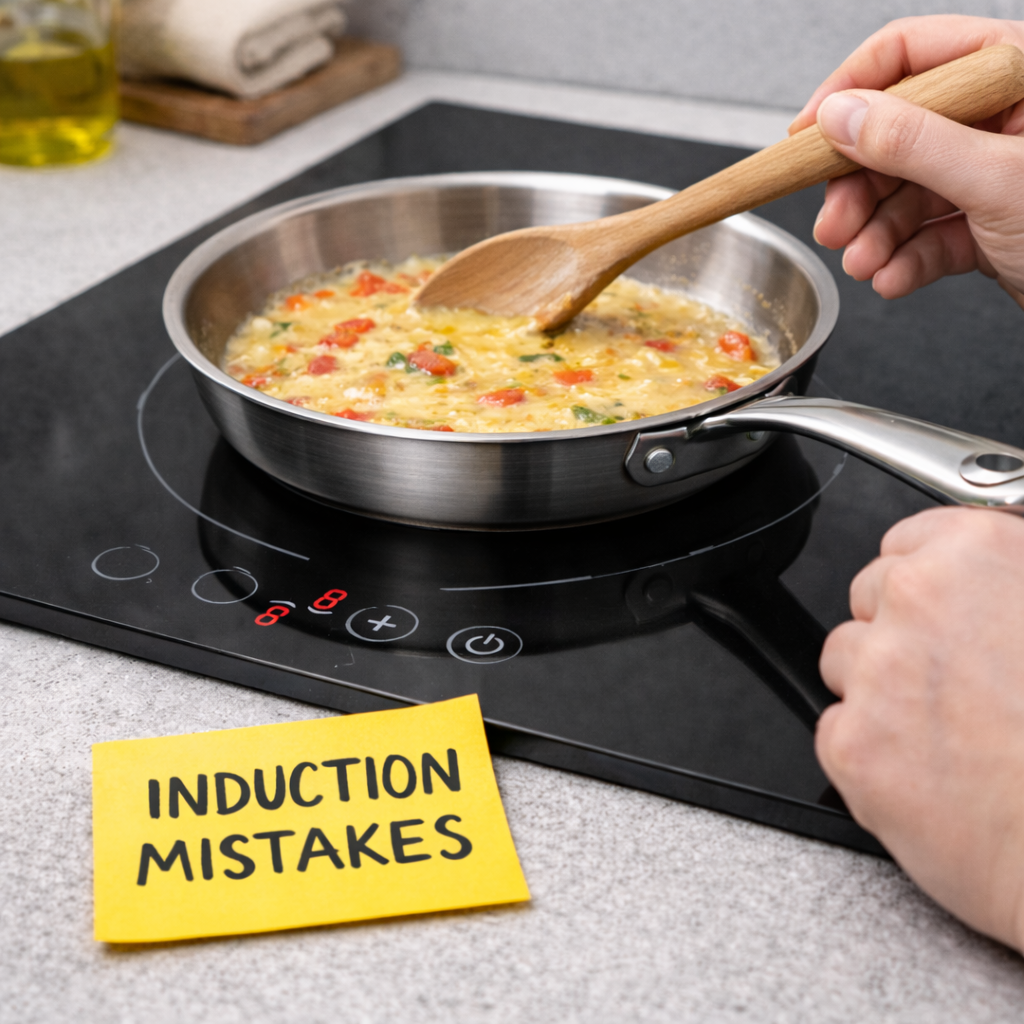
Induction cooking is fast, efficient, and precise. But it also behaves differently than gas or traditional electric stoves. That difference is where most beginner frustration comes from.
Many common induction cooking mistakes happen because people carry over habits from other types of stoves. Once cookware, power settings, and expectations adjust, induction becomes far more predictable.
Below are the most common induction cooking mistakes beginners make and how to fix them.
The short answer
Most induction cooking problems are caused by cookware choice, power settings, or expectations carried over from gas or electric cooking. Small adjustments in these areas usually solve the issue quickly.
The most common mistakes include:
- Using poorly performing cookware
- Cooking at power levels that are too high
- Expecting steady heat at all settings
- Moving pans too often
- Misunderstanding normal induction sounds
Using pans that technically work but perform poorly
One of the biggest mistakes is assuming that any pan that heats on induction is good enough.
Some pans pass basic compatibility tests but still cause:
- Buzzing or clicking noises
- Uneven heating
- Burners shutting off
- Difficulty simmering
These issues often come from thin bases, weak magnetic layers, or warped bottoms.
What to do instead
Use pans that are induction compatible and well built, with flat, heavy bases that sit securely on the cooktop.
(See more: How to tell if your pan is induction compatible)
Cooking at power levels that are too high
Induction delivers heat much faster than most people expect. Power levels that felt normal on gas or electric can be excessive on induction.
This often leads to:
- Scorched food
- Sudden boil overs
- Burners cycling on and off
- Cooktop shutoffs
What to do instead
Start lower than you think you need. Increase power gradually as you learn how your cooktop responds.
Expecting steady heat at all settings
Unlike gas, many induction cooktops regulate temperature by pulsing power. At lower settings, that pulsing can feel inconsistent if you are not expecting it.
Many beginners mistake this behavior for a malfunction.
What to do instead
Understand that light cycling is normal, especially when simmering. Focus on results rather than whether the burner feels constantly on.
(See more: How induction cooking works)
Moving or lifting the pan too often
Induction burners rely on constant pan detection. Sliding or lifting a pan repeatedly can interrupt that detection and cause the burner to shut off.
This is especially common when:
- Shaking pans
- Stirring aggressively
- Sliding cookware instead of lifting it
What to do instead
Lift pans straight up and set them back down centered on the burner. Keep cookware stable during cooking when possible.
(See more: Why does my induction cooktop keep turning off while cooking?)
Ignoring burner and pan size matching
Induction burners are sensitive to pan size. A pan that is too small or too large for a burner may not heat evenly or may not be detected reliably.
This can cause:
- Weak heating
- Hot spots
- Flashing indicators or shutoffs
What to do instead
Match pan size to burner size as closely as possible and center the pan before turning the burner on.
Worrying about normal induction noises
Clicking, buzzing, or faint humming can be alarming if you are new to induction. Many people assume these sounds indicate a problem.
In most cases, they do not.
What to do instead
Learn which sounds are normal and which are not. Pan construction and power level often affect noise more than the cooktop itself.
(See more: Why does my induction cooktop make clicking or buzzing noises?)
Expecting induction to feel exactly like gas
Induction is neither gas nor traditional electric. Expecting it to behave the same way often leads to frustration.
It heats faster, responds differently, and rewards slightly different habits.
What to do instead
Treat induction as its own tool. Once expectations adjust, its advantages become much clearer.
Is induction harder to learn than gas or electric?
Induction has a short learning curve, but most people adapt quickly. Once you understand cookware behavior and power levels, many find induction easier and more consistent than other cooking methods.
The bottom line
Most induction cooking problems are beginner problems, not equipment problems. Small changes in cookware, power levels, and habits make a big difference.
Once those adjustments click, induction cooking becomes faster, quieter, and more predictable than many people expect.
If induction has felt frustrating so far, that phase usually passes quickly.