One of the most common frustrations with induction cooking is simmering. Water boils too hard. Soups bubble aggressively. Sauces feel like they jump between too hot and off.
Many new owners ask whether you can simmer on an induction cooktop without constant boiling or babysitting. That confusion is understandable.
The short answer is yes. Induction can simmer very well, but it requires a slightly different approach than gas or traditional electric cooking.
The short answer
Yes, you can simmer on an induction cooktop.
What makes it feel difficult at first is that:
- Induction delivers heat differently than gas
- Low power settings often pulse instead of staying constant
- Cookware choice matters more at low heat
Once you understand these differences, simmering becomes much easier and more predictable.
Why simmering feels harder on induction
On gas stoves, simmering comes from a small, steady flame. On traditional electric stoves, it often comes from a consistently warm coil.
Many induction cooktops work differently. Instead of delivering a constant low level of heat, they regulate temperature by pulsing power on and off. The average heat is correct, but the delivery can feel uneven if you are not expecting it.
This behavior is normal and does not mean the cooktop is malfunctioning.
(Read more: How induction cooking works)
Start lower than you think
One of the biggest simmering mistakes on induction is starting too hot and trying to dial it down later.
Because induction responds quickly, overshooting the temperature early makes it harder to regain control.
What to do instead
- Bring food to a boil at a moderate setting, not maximum
- Reduce power earlier than you would on gas
- Give the cooktop a minute or two to stabilize
Many people discover that their ideal simmer setting is much lower than expected.
Pan choice matters more at low heat
Simmering exposes weaknesses in cookware more than high-heat cooking.
Thin or lightweight pans heat and cool too quickly, which exaggerates induction’s pulsing behavior. Heavier pans with thick, flat bases hold heat longer and smooth out temperature changes.
If simmering feels impossible, the pan is often the limiting factor.
(Read more: How to tell if your pan is induction compatible)
Match the pan to the burner
Using a pan that is too small or too large for the burner can make low heat cooking unstable.
Poor burner matching can cause:
- Inconsistent heating
- More noticeable cycling
- Burner shutoffs at very low power
Center the pan carefully and match its size to the burner whenever possible.
Expect gentle cycling, not a steady bubble
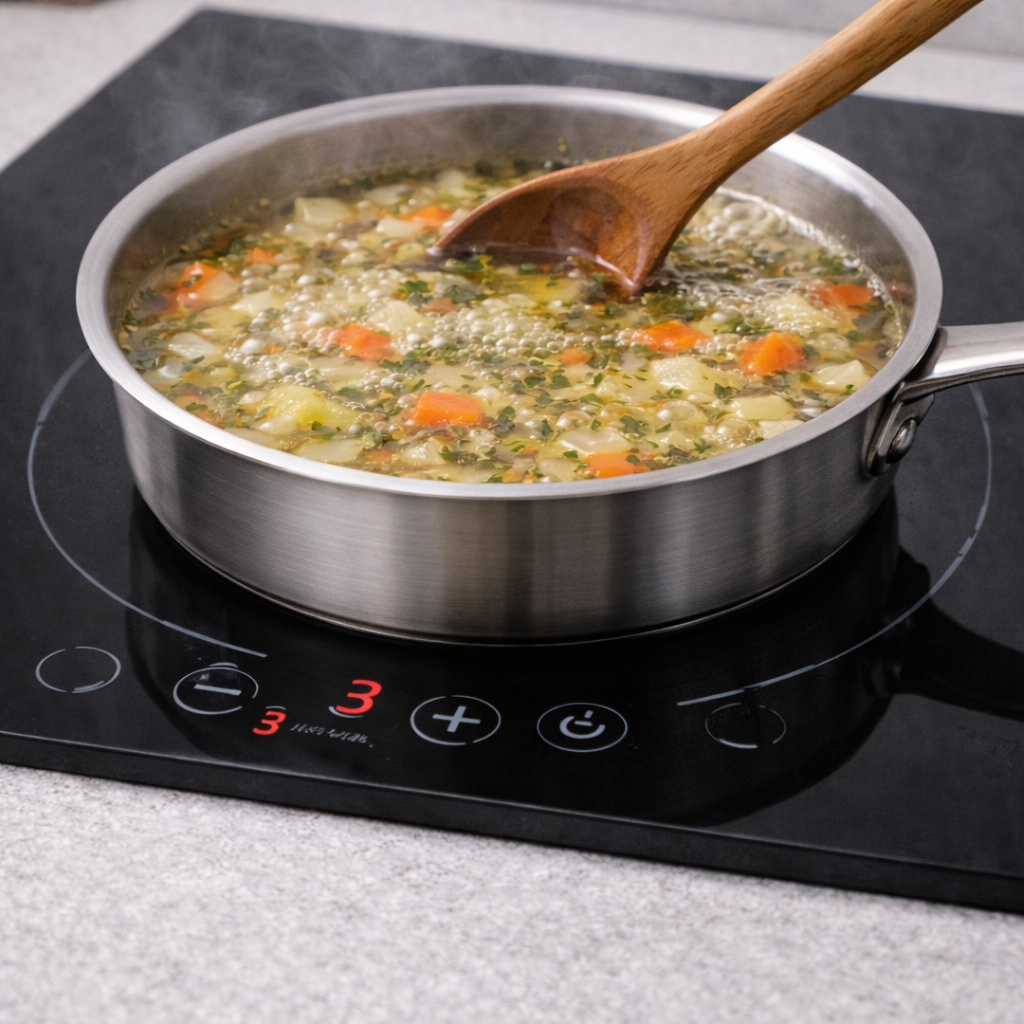
On induction, a proper simmer does not always look like a constant stream of tiny bubbles.
You may see:
- Brief bubbling
- Pauses with little visible movement
- Gentle bursts of heat
This is normal. Judge simmering by results, not appearance.
When simmering still feels frustrating
If simmering continues to feel difficult, try:
- Lowering the power one more level
- Switching to a heavier pan
- Reducing pan movement
- Letting the cooktop run a few minutes to settle into rhythm
Many simmering problems disappear once the system reaches equilibrium.
Why does my induction simmer turn on and off?
Many induction cooktops control low heat by pulsing power rather than delivering a constant low output. This on-and-off behavior maintains the correct average temperature and is normal for induction cooking.
The bottom line
Yes, you can simmer on an induction cooktop. It just behaves differently than many people expect at first.
Once you adjust power levels, cookware, and expectations, induction simmering becomes reliable and repeatable. For many cooks, it eventually feels easier than gas because temperatures stay more consistent over time.
If simmering has been your biggest frustration with induction, this is often the turning point.
(Read more: Common induction cooking mistakes beginners make)